
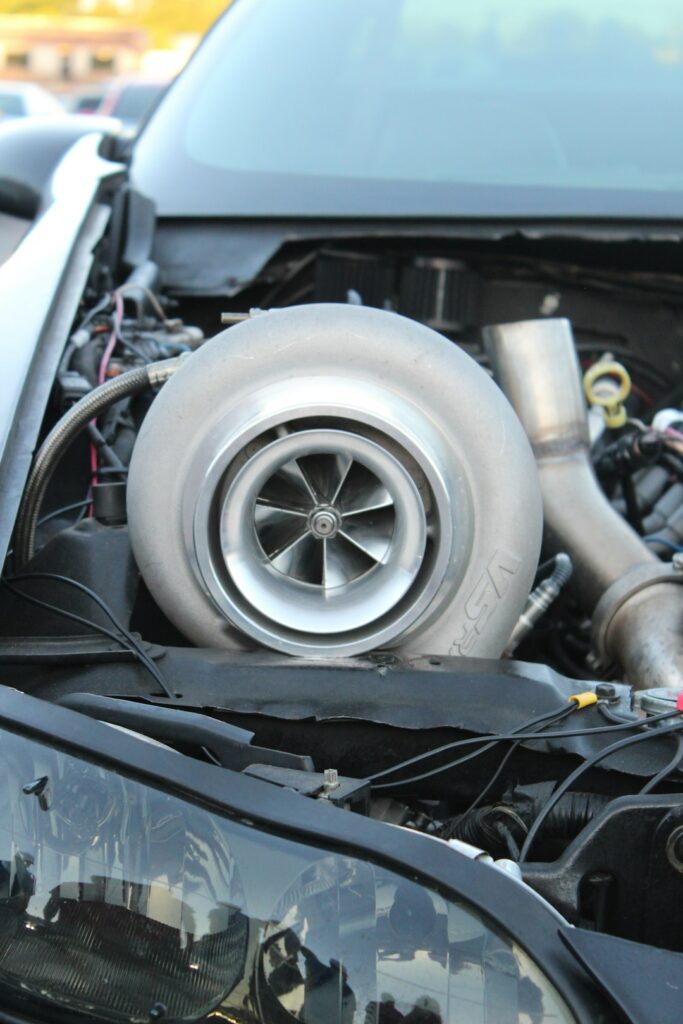
HPT Turbos: Spool, Fit, and Power
Choosing a turbo for a street car is less about finding the largest advertised flow figure and more about matching the unit to how the car is used. A larger turbo may offer more headroom, while a smaller one can build useful boost sooner. That trade-off should guide how HPT Turbos are assessed. Start with engine displacement, intended rpm range, fuel, gearing, vehicle weight, and driving conditions. A turbo that makes its strongest power near redline may feel disappointing in a daily car that spends much of its time below 4,000 rpm. Spool describes how quickly a turbo builds useful boost after the throttle opens, but several parts of the engine determine that response. Turbine size, exhaust energy, displacement, cam timing, and the turbine housing all matter. A smaller housing generally accelerates exhaust gas through a tighter passage and can improve low-speed response, though it may increase backpressure at high rpm. A larger housing may respond later while reducing restriction near the top of the rev range. Hypothetically, a two-liter track engine that stays above 5,000 rpm can tolerate later response more easily than a heavy street hatchback used for commuting. The compressor map helps replace guesswork with a view of how the turbo may operate across airflow and pressure ratio. Airflow is the amount of air the engine consumes, while pressure ratio compares compressor outlet pressure with inlet pressure using absolute pressure. Operating near the map’s efficient center generally supports lower charge temperatures and more predictable behavior. Too far to the right can produce choke, where the compressor cannot move much additional air. Near the left edge, surge can occur when airflow becomes unstable. Simply raising boost does not correct either condition, so the engine’s expected airflow must be considered. A/R ratio creates another choice between response and high-rpm breathing. It compares a housing’s cross-sectional area with the distance from that area to the turbine wheel. A lower turbine A/R often favors earlier response but can restrict exhaust flow as engine speed rises. A higher A/R can support the top end, with slower response as the likely cost. Compressor housing selection also affects outlet direction and installation space. Before ordering, check manifold fitment, wastegate arrangement, oil drain position, downpipe clearance, intake routing, and room around nearby components. A suitable turbo on paper can still create an awkward or expensive installation. Consider a clearly hypothetical 2.0-liter street car aimed at moderate power and a broad torque curve. A compact G Series II option could suit that use if its compressor map covers the engine’s expected airflow and its turbine housing matches the desired response. Now compare a hypothetical 3.0-liter engine built for high-rpm circuit work. A larger frame may fit that purpose even if it feels softer when leaving a corner. These are not universal size rules. Engine efficiency, gearing, altitude, fuel quality, exhaust design, and vehicle weight can make the same turbo feel lively in one combination and lazy in another. Supporting hardware determines whether the selected turbo can work as intended. An intercooler lowers compressed-air temperature, which increases density and can reduce detonation risk. The wastegate controls turbine drive by bypassing some exhaust gas, while a blow-off or bypass valve manages pressure when the throttle closes. Fuel injectors, pump capacity, engine calibration, and exhaust flow must match the target. A restrictive intake or undersized exhaust can limit the expected result. Stable oil supply, correct drain routing, and sound crankcase ventilation also matter because the turbocharger depends on proper lubrication and pressure control. Before buying, write down the desired power band, realistic boost target, fuel type, intended use, and future plans. Then compare compressor-map placement, turbine housing options, control strategy, supporting parts, and physical fitment rather than relying on one headline specification. A fast-spooling setup may make a street car more enjoyable and place less demand on the engine, while a larger unit may leave more room for future power and hold airflow better at high rpm. For broader turbocharger system planning, treat the installation requirements as seriously as the performance figures. The sensible choice is the one that matches the complete vehicle and its actual driving pattern.